Friday, August 5, 2011

Australia (2008)

Kidman & Jackman Sitting In A Tree....
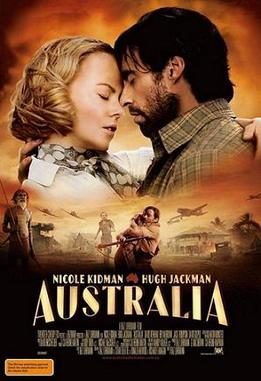
- I have never been to Australia but I hope for the sake of those who live there (and those who have visited, I suppose) that the continent is nothing like the 2008 film of the same name: a boring, predictable and pastel place full of shallow people. Baz Luhrmann (Moulin Rouge! (2001), Romeo + Juliet (1996)) directs girlie heartthrob Hugh Jackman and the never aging Nicole Kidman in this lackluster outback adventure.

Kidman stars as Lady Sarah Ashley, an English aristocrat who is forced to live and is completely out of her element in the Australian outback. The Sarah Ashley character is stunningly similar to Kidman's character in the 1992 epic Far And Away, Shannon Christie, who is also a European aristocrat (only an Irish one) - but watch out: Kidman's Shannon and Sarah are both unpredictable and adapt quickly to their new ruffian lifestyle! Also similar to the Shannon Christie character, Sarah Ashley falls for the seemingly irresistible tough guy: in the case of Australia, this happens to be Hugh Jackman's character Drover, who is - you guessed it - a cattle drover. The two spend their time quarreling and taking passionate but fleeting glances at each other as they waste the audience's time meeting a magical Aborigine child, struggling to ward off a wealthy cattle owner who wants their land, driving cattle across the Australian wilderness, and trying to survive the Japanese bombing of the city of Darwin when World War II hits their shores.

It is hard to believe that the film could be more bland and predictable than it is in its current form. No characters can be found in the film, only cereal box cut out versions of some. Kidman is the dainty aristocrat who has to pick herself up from the bootstraps and live out in the wild, Jackman is the dreamy broad-shouldered tough guy who is strong but also tender (just how the gals love them: completely unrealistic), David Wenham is the seedy double-crossing bad guy who will stop at nothing to get his way, Brandon Walters is Nullah the Aborigine with a heart bigger than the whole of the continent - find me a genuine character in the film and I will buy you a Coke. On top of featuring this toneless cast of characters, the near three-hour film is made worse by the thick pastel coloring and boring cinematography, which makes the film look like its sets were made out of clay.


This epic is an epic failure.


CBC Rating: 4/10

The Sundowners (1960)

A Downer

- As much as it pains me to say this, as both a huge fan of Robert Mitchum and Deborah Kerr, how Fred Zinnemann's 1960 film The Sundowners was nominated for five Oscars (let alone more than just the one for Kerr) is beyond all understanding. Half-following around the Carmody sheep droving family around the Australian outback, The Sundowners never seems to be able to pick up the pace or begin to tell a solid story.

Robert Mitchum and Deborah Kerr reunite for their second film three years after the excellent John Huston film Heaven Knows Mr. Allison (1957) in The Sundowners. Mitchum plays Paddy Carmody, an Irish-Australian man who loves to be on the move from job-to-job and place-to-place; Deborah Kerr plays Paddy's wife Ida who is never afraid to speak her mind and has had enough of the Carmody's nomadic lifestyle; and Michael Anderson Jr. is Paddy & Ida's only child, Sean, who is also eager to stop moving around to settle down and manage a farm.

So there you have it: the Carmody family is divided between a father who wants to keep his adventurous life on horseback and a son and mother who want to take life easy in a home. The Sundowners does touch upon this story arc from time to time and when it does the film is interesting and engaging but unfortunately never dwells on this aspect of the story long enough to make it an interesting focal point of the film. Instead, we see the Carmodys lead sheep across the Australian outback, shack up with a loud and half-in-the-bottle sheep-shearing outfit and try to race a racing horse, putting the family tension storyline out to pasture throughout the film.

The effectiveness of the film is hoisted upon the starring shoulders of Mitchum and Kerr, who are highly entertaining in a slow-moving film with basically no cohesive story and the sun as its only source of lighting (the cinematography seen here is as boring as the art form gets). Both Mitchum and Kerr do a more than admirable job but only have the help of Peter Ustinov - who excels in a supporting role as the Carmody's loyal family friend Rupert Venneker - to make the film watchable. The three great performances are enough to make The Sundowners worthwhile but they are not enough to declare it fantastic or a "must-see" film as its five Oscar nominations might suggest.


CBC Rating: 6/10

Bird (1988)

A Noble Effort

"There are no second acts in American lives." - F. Scott Fitzgerald

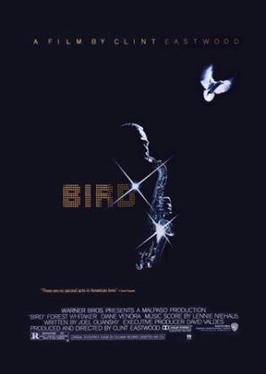
- A poignant phrase to set the tone for the film, the quote above by F. Scot Fitzgerald is used to open Clint Eastwood's1988 film Bird about the life of jazz saxophonist Charlie "Yardbird" Parker. In fact, the quote captures the essence of the wasted life of Bird Parker, the brilliant trail-blazing musician cut down by the vices of substance, probably better than the entire film did. One can tell that director Clint Eastwood and company put in a lot of time, effort, and passion into Bird; unfortunately, the film suffers from a few crippling drawbacks.

The quality of the film's visual presentation is beyond question. Clint Eastwood and cinematographer Jack N. Green paint a very visually stimulating picture of Bird's life in the 40s and 50s - from the picture quality to the art direction, Bird looks terrific.

The film is also filled with excellent music - from the original music from Lennie Niehaus to the source jazz used for the film. Looking and sounding good is important for a film - and in the case of Bird, enough to carry it into the above average category - but there has to be more, and Bird does not fly high enough to achieve it.

Bird is often called a "tribute" to or "collage" of Parker's life, rather than existing as a pure biography film. Such words do describe the film's intentions well; unfortunately, Bird is a bit too collage-like for its own good. The film jumps around in time and space too much and one often wonders where they are within the film - it makes the film messier and harder to follow.

On top of this is the acting, which fails to be anything spectacular. None of the principles really shine - Samuel E. Wright gives the best performance in the film but he is in a small supporting role. Forest Whitaker gives an impassioned, sometimes powerful, portrayal of Charlie Parker but never seems to really get a hold of the character and Diane Venora gives a clear example of outlandish overacting as Chan Parker (Bird's bird) and it completely ruins scenes.

As a big fan of Clint Eastwood and jazz music, I really wanted to love this movie but because of the messy narrative and substandard acting I simply could not. Bird remains a noble effort by Eastwood and Whitaker but not a great film.


CBC Rating: 6/10