Friday, May 11, 2012

Invictus (2009)

"I am the master of my fate:
I am the captain of my soul."

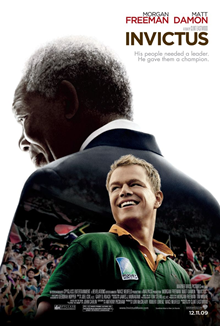
- The western genre.... Dirty Harry.... The last things usually associated with Hollywood legend Clint Eastwood are South African politics and rugby. Yet Eastwood present both unusually paired elements together in the impressive inspirational 2009 film Invictus about South African President Nelson Mandela and national rugby team the Springboks.

The events of the story begin at the end of the Apartheid regime in South Africa and the election of Nelson Mandela. Despite the extension of suffrage in South Africa, racial tensions remained high between the black and white populations. Unity was essential if South Africa was to endure and, in the face of opposition, President Nelson Mandela (Morgan Freeman) looks to the nation's ruby team, the Springboks, and their Captain François Pienaar (Matt Damon) for an unlikely source of national identity.

Invictus is not one of Clint Eastwood's finest films but it is undoubtedly, in my view, a quality film. Eastwood (with fellow cohort, cinematographer Ton Stern) exercises his signature keen eye for visuals and professionally assembles the affecting story into a nicely flowing final product. However, Invictus does lack a certain power in the way the narrative unfolds. The viewer gets a great sense of the pickle that Mandela finds himself in (thanks to both Eastwood's direction and Morgan Freeman's performance) but seldom do events in the plot come to a head and the ending is particularly anti-climactic. Also, the practical deification of Mandela is very noticeable and a bit troubling from a historical perspective. Mandela was an important and interesting man but he had his imperfections as everyone does; hell, the film forgets that Mandela was imprisoned for his involvement with armed insurrections that killed innocent civilians! Finally, a rare, puzzling misstep for Eastwood in this film is the inclusion of a few corny and overbearing music montages. I still cannot believe that those lousy scenes made it into a Clint Eastwood film.

Both of the film's stars Morgan Freeman and Matt Damon were nominated for Academy Awards for their performances as President Mandela and Francois Pienaar, respectively, and, for my money, were the highlight of the film. While I could name other actors that I feel gave better performances during the 2009 film year, it is clear to me that both Freeman and Damon each perform their characters at career-high levels. It seems to me that Matt Damon is only impressive when working for truly great directors like Martin Scorsese (in The Departed (2006)), the Coen Brothers (in True Grit (2010)), Steven Soderbergh (in a number of films; most notably The Informant! (2009) and the Ocean's Trilogy) or Clint Eastwood in Hereafter (2010) and here in Invictus. More than most, Eastwood seems to be especially adept at repressing Damon's inner unbearable leading man and harnessing the man's true talent for character acting. Damon is quiet and subdued in Invictus as the focused Pienaar to great effect.

I am often critical of Hollywood actors playing very recognizable real-life people. More often than not, actors seem to be doing impressions rather than creating a character with their performances of historical figures in Hollywood biopics. Such performances tend to be hammy and pivot on exaggerated recognizable traits in their characters that hint that they are simply doing it all in a desperate attempt to win awards and impress on a superficial level (look how much I act like so-and-so, I bet you can't tell it's me!!). It take a very special actor and performance to impress me in this way (such as Robert Downey Jr. in Chaplin (1992) or Liam Neeson in Michael Collins (1996)). However, I found Morgan Freeman's performance of Nelson Mandela to be quite good. Freeman resembles Mandela greatly but also simply creates a very sympathetic character; his subtle, distinguished and authentic authority playing well to the calm wisdom of the determined peacemaker. And despite Mandela's portrayal as a deity to a certain extent in Invictus, it is certainly not carried out through the individual efforts of Morgan Freeman.

Although I do not rank Invictus among the very best of Eastwood's remarkable filmography, I do find it to be a well-made and entertaining film. Invictus has some small problems when it comes to pacing, narrative, historical and filmmaking choice aspects that add up to significantly detract from the overall experience. However, Eastwood is a master at the craft of filmmaking and none of his films can be overlooked, let alone Invictus with the strong sense of visual style and unique atmosphere; and, of course, Morgan Freeman's career highlight performance of Nelson Mandela is another obvious incentive to see this film.


CBC Rating: 7/10

Leatherheads (2008)

Clooney Tackles Comedy

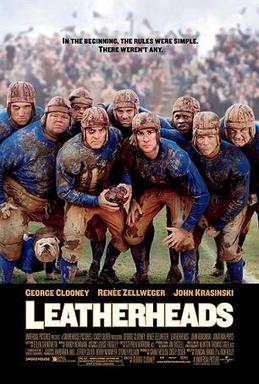
- On top of being one of the most celebrated actors of our day, George Clooney is also an accomplished director of such films as Confessions Of A Dangerous Mind (2002), Good Night And Good Luck (2005) and The Ides Of March (2011). Of the four films that Clooney has directed, 75% of them are (in general) politically inclined dramas but his 2008 comedy Leatherheads is a delightful departure. A modern remix of the classic screwball comedy genre set in the 1920s, Leatherheads is a very enjoyable film; not one of Clooney's best pictures but sorely underappreciated.

Clooney stars as Dodge Connelly, an aging veteran in the infant era of professional football when shenanigans and dirty play were simply part of the fabric of the game. As the longtime captain of the Duluth Bulldogs (Clooney wanted to name the team after the actual 1920s Duluth squad the Eskimos but the NFL would not allow it since the film featured drinking), football is really all that Connelly knows - that and getting under people's skins - and he finds himself being left behind as the nature of football begins to change. Because the Bulldogs are going under due to lack of fans and funding, Dodge is forced to bring in Carter "The Bullet" Rutherford (John Krasinski), college football sensation and war hero, to fill the seats and keep the team alive. But complications arise when Chicago Tribune writer Lexi Littleton (Renée Zellweger) steals the hearts of both Dodge and Carter while trying to expose Carter's war record.

Leatherheads is a refreshing, rebellious throwback to the early screwball comedy genre. The film's greatest strength is the way in which Clooney employs a vintage visual and comedic style that mirrors the madcap screwball comedies of the 1920s, 1930s and 1940s. The Roaring Twenties are presented in this film with the glamor and panache of Hollywood's Golden Age in a way that uniquely compliments the mud-slinging old-fashioned style of football. The audience is further transported to the 1920s with very effective production design and wardrobe teams as well as a swinging Randy Newman old-timey score.

Naturally, Clooney assembles a great cast for the film. John Krasinski of NBC's "The Office" is perfectly cast as the all-around boy wonder Carter Rutherford, Renée Zellweger invokes a Rosalind Russell brand of 20s tough-girl reporter through her performance of Lexi Littleton, Jonathan Pryce makes for one hell of a slimy agent as Carter's cutthroat agent CC, and Stephen Root is incredibly funny as the sleepy, drunken small-town writer Suds. Clearly, Clooney called in the right amount of favors, each actor in the film is memorable and makes their characters likable. Clooney himself is his full definitive swing; an echo of his Coen Brothers comedic persona as the pathetic but charming Dodge Connelly.

Although quite enjoyable, Leatherheads is ultimately not Clooney's strongest directed film. Clooney's talent for visual style, the likability of the cast and the effectiveness of the film's humor makes for a fun 114 minutes but the story is difficult to become engaged with. The specifics of the plot move the film along in an amiable way but the flow is off track, lacking the fluidity necessary to bring the story to life. The story strolls along and acts as an entertaining foundation for the characters to act and react upon but it never forms into anything resembling a climax. It's a shame. Leatherheads has a lot to enjoy and admire but simply cannot make the cut of a great film.


CBC Rating: 7/10

Wednesday, May 9, 2012

Quills (2000)

Beastly

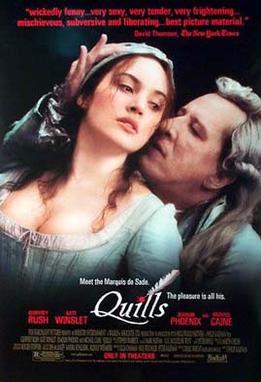
- Paris 1794: one the most repulsive tales told on screen - and no, unlike how it is portrayed in this film, it is not a good thing. Quills (2000) is the nasty story of the truly abhorrent Marquis de Sade and his slip into complete madness when he is unable to write his pathetic and disgusting filth. One of those sickening films that makes you frustrated and cynical about the entire world, I hated every aspect of Quills.

Now, the four main actors give good performances in principle - Geoffrey Rush, Kate Winslet, Joaquin Phoenix, and Michael Caine are all believable in their roles and there is not a weak moment from any of them. Also, the costumes and set-decoration are also well done. However, four good performances and nice window dressing are not going to leave much of an impact on a wretched, disgusting decomposing carcass of a movie.

Although the film is set in the past, it is easy to see what it is trying to do - take the same questions posed in late 18th early & 19th century France and position it in our day and age. Quills is not subtle in its presentation of anything but the film is especially not subtle with its message. Yes, yes, I get it: freedom of expression, love, art, withholding art can drive you insane, blah blah blah - YAY ART! Now, I agree with the freedom of expression and art - life is not the same without art. However, the Marquis de Sade's story is not the right lens on which to get this message across and the filmmakers do it in an unpleasing and insulting way.

The Marquis de Sade's writings are arguably art in the first place. Writing about sex for pages and pages is art? In technical terms it is in that something is created out of nothing through words, but in logical terms it is not art, it's smut. Those who did not like the Marquis de Sade's writing back in the day, Napoleon Bonaparte being one of them, had him committed to an insane asylum and took everything he could possibly use to write his ideas down. Ah yes, I suppose that people who do not approve of The Marquis de Sade's 18th century version of Ron Jeremy films or any other forms of erotic "art" are a bunch of Napoleons or modern day versions of one? They wish.

As if that were not enough, Quills has more to say. Without batting an eye, the film questions whether the horrid actions inspired and carried out by people after hearing the Marquis de Sade's words are taking the words at their face value, or just misusing them. However, there is no doubt that Christianity is causing all sorts of evils, even being the reason that the Marquis de Sade's tongue is cut out. Now wait a minute, where is the questioning of whether or not Christianity was actually being misused by human beings? Oh, how silly of me, this is Hollywood - they would go full-out Nero if it was possible.

With the despicable messages Quills tries to pass on to the viewer, the film's TV look and feel does not help anything out. Let me get this straight, they could budget for Michael Caine but not for a good cinematographer? One detractor in the film is quite funny though. Quills tries to make things look like the Marquis de Sade lead all of France to discover sex, as if Paris pubescents alone had not figured out were all the parts go and the whole nine yards! I of course do not even have to mention to those who have seen the film of the fortune's worth of completely disgusting scenes featured in Quills. I especially would have preferred going my entire life without seeing Geoffrey Rush naked, Geoffrey Rush trying to seduce Joaquin Phoenix, and Geoffrey Rush trying to seduce Joaquin Phoenix while naked.


CBC Rating: 3/10