Monday, July 16, 2012

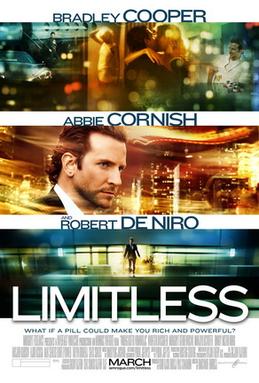
Limitless (2011)

Limited

- What if a pill could deliver the American Dream of immense success to you on a silver platter? In today's society that demands instant gratification and results, the idea of a pill that could make our lives better in every area sounds very appealing. When broke, washed-up and altogether ambitionless writer Eddie Mora (Bradley Cooper) gets the chance to try an experimental pill, a drug called NZT, that would allow him to use 100% of his brain, instead of the 20% norm, he jumps at the chance. The pill works better than he could have imagined, allowing Eddie to finish his book and become a star on the stock-trading stage. But on his way up on Wall Street, Eddie comes crashing down in a sea of danger as powerful people try to kill him before drug dependence does.

Ignoring for a moment that the "10% myth" (in this case, the film suggests the figure is 20%) has not been laughed at and disproved by scientists.... OK, I can't ignore it! The main idea in which the plot swivels upon - that people do not already use 100% of their brains on a daily basis - is pretty ridiculous and it is difficult to base a thoughtful plot on a fallacy. But the affects that NZT has on Eddie's life make for a good story and, thanks to this interesting aspect of the plot as well as some competent direction, Limitless (2011) is a marginally entertaining film based on Alan Glynn's novel The Dark Fields.

The story has a few problems but the specific ways that the side effects of NZT play out in Eddie's life are quite interesting; everything he could possibly want comes true when he is able to basically do anything he wants to anybody - but he faces the consequences for his actions as well.... To a point.

****SPOILERS HERE!!****
The ending really rubbed me the wrong way. While Eddie is briefly met with some potentially life-threatening responses to his actions throughout the film, very little character development occurs. He is supposedly able to use 100% of his brain but never really seems to learn anything! Rarely does morality factor into his actions or reactions and when it does, it quickly recedes into.... What? The one brain cell that he is not using, I suppose? This could have been part of the idea behind the theme of the film, except that the film seems to hint at the opposite: everything ends up working out for good 'ol Eddie by the time the credits begin to roll - never mind that he is permanently hooked on NZT, dedicating his life towards great power over others and gratification for his own selfish desires and gaining enemies left and right. I guess the drug worked out after all, to the point where he gets a very twisted Walt Disney ending! This is wrong on a very important level. Even if a character remains a morally repugnant character at the end of the film, it is supposed to at least register with the character that his life has been ruined or that he is at least a bad person who must limp on through the consequences that he has carved out for himself (i.e. the end of The Godfather Part II (1974)). Anything else feels disingenuous.
****END OF SPOILERS****


Anyway, what ultimately made Limitless watchable for me was the specific visual work of director Neil Burger (The Illusionist (2006)). Burger usually directs *and* writes his films but Limitless is the first film that he has simply directed. Clearly not as strong a film as the incredible The Illusionist (perhaps because Burger had no significant work on the development of the screenplay for Limitless), Burger does an impressive job crafting the visual aspect of the film. Employing a snazzy style and a lot of cinematic tricks to enhance the audience's perception of NZY, Burger effectively allows the audience to feel the effects of the drug through the visuals. No special CGI effects are required - just some old fashioned inventive filmmaking. Unfortunately, where he excels as far as style goes, Burger was unable to bring his cast to a similar high level. I am just not a big Bradley Cooper fan (he is better than the original choice of Shia Labeouf though!). Cooper, with his shallow and cocky demeanor, works OK in things like The Hangover (2009) and The A-Team (2010) but really fails to convince when portraying a character grappling with anything serious. Abbie Cornish and Robert De Niro are pretty boring in their supporting roles; the character that Cornish portrays could have been played by any actress that can speak English and De Niro is simply coasting along as usual, having not given a good performance since Ronin in 1998. So although I was significantly disappointed by Limitless, I hope to see more from a clearly talented Neil Burger.

CBC Rating: 6/10

Friday, June 22, 2012

Just Go With It (2011)

Could've Gone Without It
 
- Adam Sandler is a talented man and often uses his acting powers for good. Punch Drunk Love (2002) and Spanglish (2004) are great examples of Sandler performing at a very high level.... However, especially as a producer, Sandler often uses his powers for evil. While Sandler can give good individual performances, his production company, Happy Madison, has yet to produce a quality film. Just Go With It (2011) is no exception to this rule; I definitely could have gone without this Happy Madison production.

Danny Maccabee (Sandler) is one clustershmuck of a playboy with one successful gimmick: he wears a wedding ring to tell a seductive sob story about a hellish life with a horrible wife. However, Danny's whole game is shaken up after making impromptu contact with the young Palmer (Brooklyn Decker), hitting things off without even putting on the fake wedding ring. But when Palmer accidentally finds the ring, things look very bleak for any kind of relationship. Because Palmer appears as if she is "the one," Danny acts quickly to try and salvage things with Palmer, making up a story that he is getting divorced. The situation becomes complicated when Palmer wants to meet Danny's fake soon-to-be-ex-wife and Danny solicits the help of his single mother secretary Katherine (Jennifer Aniston) to play the part of the conceited bitch. Things get even more complicated when an accidental slip-up alerts Palmer to the fact that Katherine has kids - of course inferring that they are Danny's kids as well.

Could things get even more complicated? Why, yes - yes they can! Katherine's kids are crafty little monkeys and make the charade very hard to keep up - little Maggie (Bailee Madison) treats the whole event like an acting part, deciding to practice her British accent, while little Michael (Griffin Gluck) uses the situation to get what he has always wanted: a trip to Hawaii to swim with the dolphins. Then Danny's cousin Eddie (Nick Swardson) shows up as Katherine's fictitious German lover "Dolph Lundgren" (not the real Dolph Lundgren) and Katherine bumps into her life-long rival Devlin Adams (Nicole Kidman) in Hawaii of all places. (Dave Matthews shows up too). Whoa! I see a huge tidal wave of supposedly funny scenarios heading our way! RUN! HEAD FOR HIGHGROUND!!!!

As one can tell, this comedic labyrinth of senselessness and adolescence barely passes for a plot. But I am sure some of you are thinking: "Come on, it's just a fun movie! Just go with it!" Well, sorry, I could not just go with it. This Happy Madison comedy is just a terrible movie, nearly void of anything resembling good humor or likable characters and is simply difficult to sit all the way through.

This film is shallow in every area from jokes to characters to story to cinematography. The star-studded cast featuring Adam Sandler, who does not get a pass for putting so much work into this awful movie; Jennifer Anistan, who does about as well as anyone could have considering the circumstances; Brooklyn Decker, who is not asked to do anything outside of look hot and act dumb; Nick Swardson, whose talent for standup does not translate well through his character in this film; and Nichole Kidman, who clearly owed someone a favor in order to appear in this film, do nothing to make the film funny or create characters that we care about. While perhaps related, there in fact *is* a difference between "low-brow" and "childish" humor - and Just Go With It takes the latter approach every time. Just Go With It seems to find foreign accents, penis jokes, dying sheep, and Botox-overdosed patients funny; meanwhile, very little wit is present within its reels. Did Adam Sandler and director Dennis Dugan (Sandler's yes man behind the camera as of late) really think that our laughs could be purchased with these worthless gags?

The only aspect of Just Go With It that I even remotely enjoyed was the liberal use of tunes by The Police throughout the film.... And even in this instance, the film managed to screw up occasionally by including not the original versions of The Police tunes but *remixes* of the songs! The film can't even get the soundtrack right!


CBC Rating: 3/10

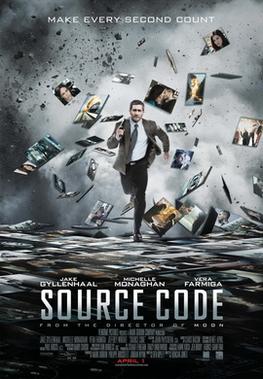
Source Code (2011)

"Look at me. Everything's going to be okay...."

- Director Duncan Jones has been on my cinematic radar since first viewing his incredible feature film debut Moon (2009). Jones' second film, 2011's Source Code, stars Jake Gyllenhaal as Colter Stevens, a man with the worst case of deja vu in history. After waking on a train, Stevens meets a woman (Michelle Monaghan) who seems to know him very well yet is calling him by a different name. He recognizes many things about this train, even anticipating moments before they happen, although to the best of his recollection he had never been on it before.

And then the train explodes.

Colter wakes up again. This time, he awakes inside some kind of pod with someone named Lt. Goodwin (Vera Farminga) trying to contact him through a television screen. Goodwin informs Colter that he is in fact Captain Colter Stevens, a helicopter pilot, and that he is taking part in an important mission using ground-breaking technology. This technology, called Source Code, allows a one person's consciousness to be inserted inside another person's body for about 8 minutes (it's a new technology, you see). The train that Colter was on has a bomb and he, inside the body of a man named Sean Fentress, must find out who that bomber is using the Source Code.

Source Code is geared for a wider audience than Jones' previous cerebral sci-fi Indie Moon but gets pretty cerebral in its own right. The story is predictable in some areas where the filmmakers must have thought the audience would have been fooled but a number of plot twists really surprise and pay off wonderfully in the end. Jones style greatly compliments the film; not measuring up to that in Moon but featuring a great balance of risk-taking style and accessible Hollywood packaging. Overall, this springtime sci-fi thriller is exciting, character centered, and much more complex than the viewer could have possibly guessed going in.

The only negative I took away from Source Code was Jake Gyllenhaal's portrayal of Colter Stevens. I will admit right off the bat that I have usually met a Jake Gyllenhaal performance with mixed feelings. Some of Gyllenhaal's performances are actually quite enthralling (such as his portrayal of Robert Graysmith in Zodiac (2007) and of the title character in Donnie Darko (2001)) but I find that Gyllenhaal, more than most young actors these days, often fails to appear natural in his roles. Subsequently, rather than being sucked into the film and character by a great performance, I am very aware that Gyllenhaal is acting and this takes away from the overall film experience. The last thing one can say about great actors like Cary Grant or Robert Downey Jr. is that they do not look or feel natural in their roles; this is, of course, one of the reasons that great actors are considered great. Unfortunately, Gyllenhaal is not a great actor and, although more passable as Colter Stevens than the norm, he is the lone but significant, sour note in Source Code. 


CBC Rating: 7/10