Friday, July 20, 2012

The Grey (2012)

Into the Grey

- I am going to cut to the chase: The Grey (2012) is not the kind of film one might immediately expect. The film was packaged as a survival adventure - man vs. nature and all of that - but this definition is simply not accurate. Reuniting A-Team (2010) director Joe Carnahan, producers Ridley and Tony Scott and actor Liam Neeson, The Grey is a very well-made and powerful film with a lot to say.

Neeson (thankfully replacing the originally-cast Bradley Cooper) stars in this film about an oil drilling team struggling to survive in the Alaskan wilderness after a plane crash. These men must survive fear, injury, hunger, the cold and, worst of all, a pack of territorial wolves that relentlessly pursue them. The Grey is an explosive and intense movie containing some incredible photography and fast paced action but it is at its core an allegorical film about life and death. So before anyone complains that wolves do not really act the way that the film portrays, keep in mind what they symbolize for the characters and the overarching themes of the story.

Liam Neeson has been in allegory-heavy films before (most notably the fantastic Seraphim Falls (2007)) and is outstanding in The Grey as Ottway, a man paid to end the lives of that which now hunts him. With recent films like The Grey, Seraphim Falls, The A-Team, Taken (2008) and Unknown (2011), Neeson has, in a way, stepped into the void left by Clint Eastwood as the aged badass of Hollywood. He has a fantastic combination of natural powerful presence and genuine emotion, which makes him one of the finest and most underrated actors around. The Grey is certainly one of Neeson's best performances in years; the pain, desperation and compassion of Ottway are all gently blended inside Neeson's deep, intense performance. Supporters Frank Grillo, Dallas Roberts and Dermont Mulroney (very satisfyingly playing against type) are also impressive in the film but Neeson stands the tallest in the spotlight.

Although occasionally getting lost in the wilderness of pretentiousness and theological canards, The Grey is an intense and thoughtful film that one rarely sees these days. It took some time while watching for me to realize that The Grey was not the survival adventure thriller I expected it to be but the realization opened my eyes to how the film was trying to convey its ideas through the story, which allowed me to enjoy the film in different way. This not to say that I agree full-heartedly with the clearly nihilistic message that is given in the film; Ottway's plea/challenge/curse to God at one point in the film was a moment of particular spiritual ignorance. However, the way that The Grey  spun its yarn is very thoughtful. I did not have to agree point-by-point to enjoy the examination of the ideas that Carnahan and Ian MacKenzie Jeffers (who wrote the original story, Ghost Walker, of which the film is based) put forth through the story. Of course, Liam Neeson's performance and the overall impressive visual and emotional nature of the film itself is entertainment enough as it is; however, the thoughtful cinematic allegory makes The Grey that much more unique.


CBC Rating: 8/10

Monday, July 16, 2012

Jane Eyre (2011)

To Eyre is Human

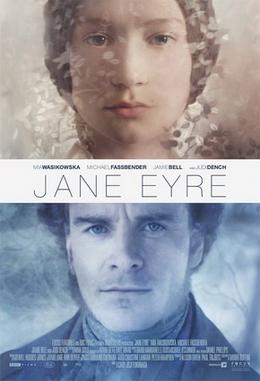
- Charlotte Bronte's classic 1847 novel Jane Eyre has been brought to the screen both big and small so many times throughout the years that one doubts that a film can portray the story any differently than what has been done before. However, Cary Fukunaga's 2011 adaptation starring Mia Wasikowska, Michael Fassbender, Jamie Bell and Judi Dench features a very modern take on the story that yields both positive and negative results.

I must confess that I have not read Bronte's novel but I have seen multiple screen adaptations of the story, my favorite being the 1983 BBC miniseries starring Timothy Dalton and Zelah Clarke. Jane Eyre features a powerful story with very interesting characters at the apex of it all. The story follows Jane's journey through a brutal experiences living with her aunt and then at boarding school to her time as a governess at the mysterious Thornfield Hall where she meets its prickly and damaged master, Edward Rochester. A long period of time is covered in significant detail throughout this story but this 2011 adaptation manages to trim it down to a two hour length (but the 1943 Orson Welles and Joan Fontaine version beats this one by over 20 minutes!). Screenwriter Moira Buffini (Tamara Drew (2010)) does an impressive job scaling Jane's entire life story down to fit inside the film's 120 minute runtime; unfortunately, the ending and entire romantic arc feel rushed which seriously detracts from the film. Other adaptations do not suffer from this; miniseries adaptations of Jane Eyre, of course, simply have more time to develop the love between Jane and Rochester because of the medium and subsequently feel more real.

The strong female lead character in Jane Eyre, was the embodiment of feminism before anyone knew what feminism was but her resolve, intellect and individualism are of interest and quite relatable to both sexes. Mia Wasikowska's performance of Jane Eyre is phenomenal. Not only is Wasikowska the perfect physical choice for the role but she portrays the complexity, intelligence and passion of Jane in a very moving way that drives the film forward. Jamie Bell, Sally Hawkins and Judi Dench all give memorable supporting performances - especially good is Dench, which, I suppose, is hardly out of the ordinary.

Michael Fassbender has been really popular since making a huge splash in Quentin Tarantino's Inglourious Basterds (2009). Although Fassbender brings a certain amount of needed intensity to the role of Rochester here in this film, I could not help but feel that his performance was greatly lacking. Edward Rochester is a bit of a grisly fellow - but his demeanor comes from an inner pain and emptiness. Fassbender, for all the positive traits he brings to the role, never conveys this important aspect of the character and really just comes off as a jerk. Contrast this with Timothy Dalton in the 1983 BBC miniseries. Dalton's  Rochester certainly boiled over now and then with anger but he was able to bring a tangible sense of vulnerability to the character through a layered performance. Fassbender simply leaves much to be desired with his rather flat performance of Rochester.

Aside from the generally great cast, the 2011 version Jane Eyre is especially unique compared to the other screen adaptations through the way it is photographed. Director Fukunaga and cinematographer Adriano Goldman create a very beautiful but also washed out and haunting look and feel to the film through a very modern indie style of filmmaking. This direction is very unique for a film set in the 1800s; the conventional way for shooting a film set in this time period is usually to go the sweeping epic(ish) and colorful route such as Pride And Prejudice (2005) and Sense And Sensibility (1995). Although I am not particularly a dedicated fan of the indie style of filmmaking, the way that Fukunaga and Goldman used it for Jane Eyre was very refreshing and, aside from Wasikowska's performance, is the highlight of the film.

Overall, Jane Eyre (2011) is a very well shot and acted film that suffers a few notable drawbacks while also being quite moving in general. Obviously not one of the best screen adaptations of Bronte's classic novel - I will point to the 1983 miniseries one last time as the staple version in my opinion - Cary Fukunaga's 2011 adaptation is still quite worthwhile for Wasikowska's performance and the refreshing visual presentation.


CBC Rating: 7/10

Limitless (2011)

Limited

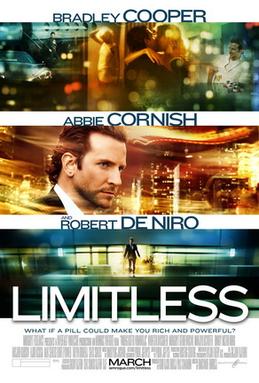
- What if a pill could deliver the American Dream of immense success to you on a silver platter? In today's society that demands instant gratification and results, the idea of a pill that could make our lives better in every area sounds very appealing. When broke, washed-up and altogether ambitionless writer Eddie Mora (Bradley Cooper) gets the chance to try an experimental pill, a drug called NZT, that would allow him to use 100% of his brain, instead of the 20% norm, he jumps at the chance. The pill works better than he could have imagined, allowing Eddie to finish his book and become a star on the stock-trading stage. But on his way up on Wall Street, Eddie comes crashing down in a sea of danger as powerful people try to kill him before drug dependence does.

Ignoring for a moment that the "10% myth" (in this case, the film suggests the figure is 20%) has not been laughed at and disproved by scientists.... OK, I can't ignore it! The main idea in which the plot swivels upon - that people do not already use 100% of their brains on a daily basis - is pretty ridiculous and it is difficult to base a thoughtful plot on a fallacy. But the affects that NZT has on Eddie's life make for a good story and, thanks to this interesting aspect of the plot as well as some competent direction, Limitless (2011) is a marginally entertaining film based on Alan Glynn's novel The Dark Fields.

The story has a few problems but the specific ways that the side effects of NZT play out in Eddie's life are quite interesting; everything he could possibly want comes true when he is able to basically do anything he wants to anybody - but he faces the consequences for his actions as well.... To a point.

****SPOILERS HERE!!****
The ending really rubbed me the wrong way. While Eddie is briefly met with some potentially life-threatening responses to his actions throughout the film, very little character development occurs. He is supposedly able to use 100% of his brain but never really seems to learn anything! Rarely does morality factor into his actions or reactions and when it does, it quickly recedes into.... What? The one brain cell that he is not using, I suppose? This could have been part of the idea behind the theme of the film, except that the film seems to hint at the opposite: everything ends up working out for good 'ol Eddie by the time the credits begin to roll - never mind that he is permanently hooked on NZT, dedicating his life towards great power over others and gratification for his own selfish desires and gaining enemies left and right. I guess the drug worked out after all, to the point where he gets a very twisted Walt Disney ending! This is wrong on a very important level. Even if a character remains a morally repugnant character at the end of the film, it is supposed to at least register with the character that his life has been ruined or that he is at least a bad person who must limp on through the consequences that he has carved out for himself (i.e. the end of The Godfather Part II (1974)). Anything else feels disingenuous.
****END OF SPOILERS****


Anyway, what ultimately made Limitless watchable for me was the specific visual work of director Neil Burger (The Illusionist (2006)). Burger usually directs *and* writes his films but Limitless is the first film that he has simply directed. Clearly not as strong a film as the incredible The Illusionist (perhaps because Burger had no significant work on the development of the screenplay for Limitless), Burger does an impressive job crafting the visual aspect of the film. Employing a snazzy style and a lot of cinematic tricks to enhance the audience's perception of NZY, Burger effectively allows the audience to feel the effects of the drug through the visuals. No special CGI effects are required - just some old fashioned inventive filmmaking. Unfortunately, where he excels as far as style goes, Burger was unable to bring his cast to a similar high level. I am just not a big Bradley Cooper fan (he is better than the original choice of Shia Labeouf though!). Cooper, with his shallow and cocky demeanor, works OK in things like The Hangover (2009) and The A-Team (2010) but really fails to convince when portraying a character grappling with anything serious. Abbie Cornish and Robert De Niro are pretty boring in their supporting roles; the character that Cornish portrays could have been played by any actress that can speak English and De Niro is simply coasting along as usual, having not given a good performance since Ronin in 1998. So although I was significantly disappointed by Limitless, I hope to see more from a clearly talented Neil Burger.

CBC Rating: 6/10