Saturday, July 28, 2012

Brave (2012)

Fate, Family & Fun

- Disney/Pixar Studios has been a consistent source for quality entertainment, a staple in Hollywood since Toy Story revolutionized animation in 1995. But throughout the years on top of the box office and critics' lists with many incredibly entertaining and visually brilliant films, Pixar never featured a story with a lead female protagonist. The fun and moving 2012 film Brave has changed this with its story of Princess Merida. However, it would be a shame if all Brave will be remembered for is its female lead character because the entire film is very touching and beautiful.

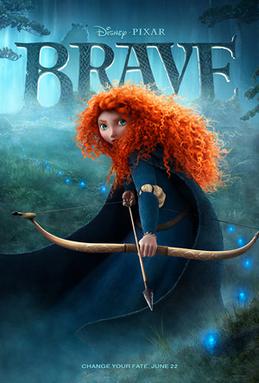
Princess Merida is not like other princesses seen in film, waiting on a windowsill singing songs about getting married to Prince Charming. No, Merida (voiced by Kelly MacDonald) defines tenaciousness and independence. She loathes her obligations as Princess forced upon her by her mother, Queen Elinor (Emma Thompson); preferring the company of her horse and bow-and-arrow and the freedom of the Celtic countryside. Merida's strong-willed nature suits her well in the great outdoors but it ends up threatening the ruin of her father's kingdom when she defies the betrothal custom of the allied clans. Merida's bravery and dedication to her family is tested when she relies on the hidden magic and sorcery of the land to change her fate.

Brave continues the Pixar tradition of amazing audiences with a terrific balance of beauty, excitement, humor and theme. The animation seen in Brave is one of the finest feats in the Pixar pantheon. Merida's fiery locks fly through a peaceful and palatial Celtic landscape to the magical mysteries of the deep woods, carrying her dreams and our imaginations away with her. A powerful soundtrack accompanies the glorious picture. I am very biased in favor of Celtic music and Brave certainly does not disappoint with a number of toe-tapping pop/folk songs and a soaring orchestral score from the great Patrick Doyle (Henry V (1989), Thor (2011)). Within the context of the Disney/Pixar feature films, the music in Brave is only bested by Thomas Newman's musical contributions (i.e.: this and this) in my view.

What if you could change your fate? I believe Brave answers this question exquisitely; but the family element to the film is also quite moving. The DunBroch clan is the source of some incredible tenderness and humor: Merida's father King Fergus (voiced by Billy Connolly) and Merida's triplet terror brothers give dimension to the love within the family and particularly embody the film's clever sense of humor. Similar to how Pixar great Finding Nemo (2003) was a powerful film about (among other things) the love between a father and a son, Brave is a very touching story about the love between a mother and a daughter. It may be a cliche but mothers and daughters often have a.... complicated relationship. Merida's youth and free-ranging spirit often clashes with her Queen mother's experience and graceful appreciation of tradition. Both love but hurt one another out of a lack of understanding; however, their adventure together opens their eyes towards a new respect for one another as well. The animation, music and humor all contribute significantly to the entertainment quality of Brave but the relationship between Merida and Queen Elinor makes the film especially emotionally investing and altogether special.


CBC Rating: 8/10

Friday, July 20, 2012

The Grey (2012)

Into the Grey

- I am going to cut to the chase: The Grey (2012) is not the kind of film one might immediately expect. The film was packaged as a survival adventure - man vs. nature and all of that - but this definition is simply not accurate. Reuniting A-Team (2010) director Joe Carnahan, producers Ridley and Tony Scott and actor Liam Neeson, The Grey is a very well-made and powerful film with a lot to say.

Neeson (thankfully replacing the originally-cast Bradley Cooper) stars in this film about an oil drilling team struggling to survive in the Alaskan wilderness after a plane crash. These men must survive fear, injury, hunger, the cold and, worst of all, a pack of territorial wolves that relentlessly pursue them. The Grey is an explosive and intense movie containing some incredible photography and fast paced action but it is at its core an allegorical film about life and death. So before anyone complains that wolves do not really act the way that the film portrays, keep in mind what they symbolize for the characters and the overarching themes of the story.

Liam Neeson has been in allegory-heavy films before (most notably the fantastic Seraphim Falls (2007)) and is outstanding in The Grey as Ottway, a man paid to end the lives of that which now hunts him. With recent films like The Grey, Seraphim Falls, The A-Team, Taken (2008) and Unknown (2011), Neeson has, in a way, stepped into the void left by Clint Eastwood as the aged badass of Hollywood. He has a fantastic combination of natural powerful presence and genuine emotion, which makes him one of the finest and most underrated actors around. The Grey is certainly one of Neeson's best performances in years; the pain, desperation and compassion of Ottway are all gently blended inside Neeson's deep, intense performance. Supporters Frank Grillo, Dallas Roberts and Dermont Mulroney (very satisfyingly playing against type) are also impressive in the film but Neeson stands the tallest in the spotlight.

Although occasionally getting lost in the wilderness of pretentiousness and theological canards, The Grey is an intense and thoughtful film that one rarely sees these days. It took some time while watching for me to realize that The Grey was not the survival adventure thriller I expected it to be but the realization opened my eyes to how the film was trying to convey its ideas through the story, which allowed me to enjoy the film in different way. This not to say that I agree full-heartedly with the clearly nihilistic message that is given in the film; Ottway's plea/challenge/curse to God at one point in the film was a moment of particular spiritual ignorance. However, the way that The Grey  spun its yarn is very thoughtful. I did not have to agree point-by-point to enjoy the examination of the ideas that Carnahan and Ian MacKenzie Jeffers (who wrote the original story, Ghost Walker, of which the film is based) put forth through the story. Of course, Liam Neeson's performance and the overall impressive visual and emotional nature of the film itself is entertainment enough as it is; however, the thoughtful cinematic allegory makes The Grey that much more unique.


CBC Rating: 8/10

Monday, July 16, 2012

Jane Eyre (2011)

To Eyre is Human

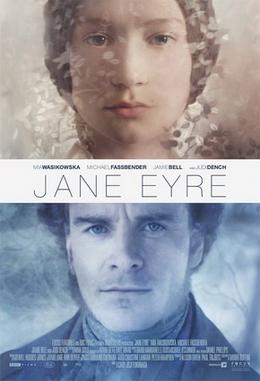
- Charlotte Bronte's classic 1847 novel Jane Eyre has been brought to the screen both big and small so many times throughout the years that one doubts that a film can portray the story any differently than what has been done before. However, Cary Fukunaga's 2011 adaptation starring Mia Wasikowska, Michael Fassbender, Jamie Bell and Judi Dench features a very modern take on the story that yields both positive and negative results.

I must confess that I have not read Bronte's novel but I have seen multiple screen adaptations of the story, my favorite being the 1983 BBC miniseries starring Timothy Dalton and Zelah Clarke. Jane Eyre features a powerful story with very interesting characters at the apex of it all. The story follows Jane's journey through a brutal experiences living with her aunt and then at boarding school to her time as a governess at the mysterious Thornfield Hall where she meets its prickly and damaged master, Edward Rochester. A long period of time is covered in significant detail throughout this story but this 2011 adaptation manages to trim it down to a two hour length (but the 1943 Orson Welles and Joan Fontaine version beats this one by over 20 minutes!). Screenwriter Moira Buffini (Tamara Drew (2010)) does an impressive job scaling Jane's entire life story down to fit inside the film's 120 minute runtime; unfortunately, the ending and entire romantic arc feel rushed which seriously detracts from the film. Other adaptations do not suffer from this; miniseries adaptations of Jane Eyre, of course, simply have more time to develop the love between Jane and Rochester because of the medium and subsequently feel more real.

The strong female lead character in Jane Eyre, was the embodiment of feminism before anyone knew what feminism was but her resolve, intellect and individualism are of interest and quite relatable to both sexes. Mia Wasikowska's performance of Jane Eyre is phenomenal. Not only is Wasikowska the perfect physical choice for the role but she portrays the complexity, intelligence and passion of Jane in a very moving way that drives the film forward. Jamie Bell, Sally Hawkins and Judi Dench all give memorable supporting performances - especially good is Dench, which, I suppose, is hardly out of the ordinary.

Michael Fassbender has been really popular since making a huge splash in Quentin Tarantino's Inglourious Basterds (2009). Although Fassbender brings a certain amount of needed intensity to the role of Rochester here in this film, I could not help but feel that his performance was greatly lacking. Edward Rochester is a bit of a grisly fellow - but his demeanor comes from an inner pain and emptiness. Fassbender, for all the positive traits he brings to the role, never conveys this important aspect of the character and really just comes off as a jerk. Contrast this with Timothy Dalton in the 1983 BBC miniseries. Dalton's  Rochester certainly boiled over now and then with anger but he was able to bring a tangible sense of vulnerability to the character through a layered performance. Fassbender simply leaves much to be desired with his rather flat performance of Rochester.

Aside from the generally great cast, the 2011 version Jane Eyre is especially unique compared to the other screen adaptations through the way it is photographed. Director Fukunaga and cinematographer Adriano Goldman create a very beautiful but also washed out and haunting look and feel to the film through a very modern indie style of filmmaking. This direction is very unique for a film set in the 1800s; the conventional way for shooting a film set in this time period is usually to go the sweeping epic(ish) and colorful route such as Pride And Prejudice (2005) and Sense And Sensibility (1995). Although I am not particularly a dedicated fan of the indie style of filmmaking, the way that Fukunaga and Goldman used it for Jane Eyre was very refreshing and, aside from Wasikowska's performance, is the highlight of the film.

Overall, Jane Eyre (2011) is a very well shot and acted film that suffers a few notable drawbacks while also being quite moving in general. Obviously not one of the best screen adaptations of Bronte's classic novel - I will point to the 1983 miniseries one last time as the staple version in my opinion - Cary Fukunaga's 2011 adaptation is still quite worthwhile for Wasikowska's performance and the refreshing visual presentation.


CBC Rating: 7/10