Saturday, December 24, 2011

A Christmas Carol (1984)

So Far, The Truest Film Adaptation
Of Dickens' Classic Christmas Tale
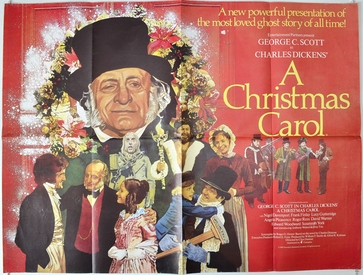
- If there is one book that is not short on screen adaptations, it is Charles Dickens' A Christmas Carol. Opinions will differ far and wide as to which film version of Dickens' tale is the best but there is little doubt in my mind that, as far as to-the-"T"-adaptations go, no other feature film version of Dickens' tale is as true to the original story than the 1984 TV movie A Christmas Carol starring George C. Scott.

I would not say that film begins and ends with starring actor George C. Scott; but Scott is a crucial part of the success of the film. Scott is an excellent Ebenezer Scrooge. With a terrific mix of the sarcasm, malice and curmudgeonness that we have all come to expect in a silver screen Scrooge, Scott brings Scrooge to life with other key components not always seen with other screen Scrooges: pain and confliction. Sometimes Scrooge's outlook on life and his fellow man is not explored in the slightest on film. Too many screen adaptations ignore why Scrooge behaves the way he does and do not show a development from "humbug" to Scrooge's redemption; the audience is simply expected to go along with it all. However, this 1984 TV adaptation clearly shows why Ebenezer Scrooge lives his life the way that he does and how his redemption progresses. As portrayed by George C. Scott, every "humbug" is birthed out of the anger and pain that Scrooge has carried around for years as a result of inescapable circumstances and personal choices he has made in the past. However, once Scrooge is presented with his life's story again first hand, he becomes conflicted, with the good man and humbug battling it out inside of him. This development of the Scrooge character through Scott's performance and good writing is unparalleled by other screen adaptations of A Christmas Carol, separating Scott's Scrooge from the rest as more than just a flat bah-humbug.

The icing on the cake comes in the form of a good film for Scott to perform within. A solid supporting cast - with such reliable and familiar faces as David Warner and Roger Rees; easily my pick for the best screen incarnations of Bob Cratchit and Fred Hollywell, respectively - add acting color around Scott's vibrant performance. The film itself is expertly packaged by director Clive Donner ( director of What's New Pussycat (1965) and the editor of another A Christmas Carol adaptation: Scrooge (1951)). Packed with generally engaging scenes, many of which have yet to be bested when compared to the many other Christmas Carol films, and featuring a crisp picture, this 1984 adaptation of A Christmas Carol is impressive as an overall film outside of the context of Scott's brilliant, scene-making performance.

I have seen a lot of screen versions of A Christmas Carol and none of them have made a stronger impact on me through the Scrooge character and adherence to Dickens than this 1984 television movie. But 1984's A Christmas Carol is not only the best screen production of Dickens' A Christmas Carol, it is one of the best TV movies ever made - all the same, it makes for an excellent yearly viewing at Christmastime.


CBC Rating: 9/10

Friday, December 23, 2011

The Muppet Christmas Carol (1992)

"'Tis The Season To Be Jolly And Joyous"
....Even for puppets!

- Charles Dickens' "A Christmas Carol" comes to cinematic life in a unique way through the Muppets and Michael Caine in The Muppet Christmas Carol (1992)! Obviously, while the overall story is the same, The Muppet Christmas Carol is not a completely faithful retelling of Dickens' original story because of the whole Muppet factor. The story is tweaked to fit a Muppet cast and some story points have been watered down or taken out to appeal more to kids (one can imagine how "Ignorance" and "Want" might terrify a child). However, while the story is not note-for-note Dickens and most of the characters are Muppets, the atmosphere, character and themes of Dickens' masterpiece have rarely been portrayed on screen to better effect. Perhaps not the most *faithful* adaptation of Dickens' A Christmas Carol point-for-point, this film is easily one of the most enjoyable versions.

What a production! We do not even blink twice as we enter a world where human and Muppet live side-by-side in the dirty but charming streets of Victorian England: the set designing is fantastic, the special effects are very cool, the songs are fun (Paul Williams and Miles Goodman write and arrange some great numbers), the humor is wonderful and, of course, the Muppets are festive! All of the major Muppets play our favorite Christmas Carol supporting characters: Kermit as Bob Cratchit, Piggy as Emily Cratchit, Statler and Woldorf as the Marley brothers, Fozzie as Fozziwig (Fezziwig) and a whole host of Muppet cameos (I especially like Honeydew and Beaker's roles) appear throughout the film. Accompanied by Rizzo the rat, the Great Gonzo is Charles Dickens and takes us through this Christmas Carol classic.

Also cranking up the entertainment and quality levels in The Muppet Christmas Carol is Michael Caine's portrayal of Ebenezer Scrooge. Caine is starring in a Muppet production but he is hardly just hamming things up. A definite front-running contender for the best screen Ebenezer Scrooge, Michael Caine incorporates plenty of effort and invests a lot of emotion in the role, creating a well-rounded character and even manages to stay subtle in the final scenes of the film (a section of the story that has killed many a Scrooge performance).

Film fans are faced with a lot of choices when looking for a fun and festive film to watch on Christmas. However, The Muppet Christmas Carol is a unique delight; a wonderful adaptation of Dickens' classic tale and an all-around fun Christmas movie.


CBC Rating: 8/10

Thursday, December 22, 2011

Scrooge (1951)

Hark! The Herald Film Snobs Sing!

- Considered by many to be the be-all-end-all of the many film adaptations of Charles Dickens' brilliant and timeless novel "A Christmas Carol," 1951's Scrooge (AKA: A Christmas Carol; depending on your geographical location) did not live up to its reputation for me.

Scrooge has many good elements that, in the end, do make it a worthwhile film. The element that undoubtedly (at least in my mind) stands head-and-shoulders above every other element apart of the film is the photography. The black-and-white photography by cinematographer C.M. Pennington-Richards services the film extremely well, ending up being one of the few things that actually grants the film atmosphere and character.

Pennington-Richards' cinematography is the only unblemished plus for Scrooge, the film's other good elements have a tailing asterisk. The film's atmosphere is created by the great cinematography, creepy music, and some then-groundbreaking special effects, but the direction could have been much stronger. Scrooge feels unfinished, not feeling like a tightly crafted cohesive whole and more like a patchwork of chapters that are stitched together ever-so-weakly by a reoccurring time travel sequence. The script has some good elements, including dialogue lifted directly from the pages that Dickens penned, but is marred by the rather large liberties taken with the story throughout the film.

Alastair Sim makes a fairly good Scrooge because he simply looks like a humbug but he is also quite disappointing for three specific reasons. The first thing that makes Sim's Scrooge disappointing is a result of the script: Scrooge is not in the process of learning anything during his Christmas Eve journey with the Spirits. He says a thing or two here or there but he eventually turns around and grumbles all the same until he reads "Ebenezer Scrooge" on the front of the tombstone. The all-important evolution of Scrooge's character, which can be seen in later versions of "A Christmas Carol," is simply not here in this 1951 adaptation. Another  disappointing feature of Sim's Scrooge is that he is too theatrical. Sim was primarily a man of the British stage rather than the silver screen and his very over-the-top-expressive manner of acting does not lend itself well to the hurt, sulking, grumble-pot that is Ebenezer Scrooge.

The third and final thing that makes Sim a disappointing Scrooge is how Sim performs the film's final scenes: after Scrooge is visited by the Spirits he finds himself reformed, I get it, but the way that Sim's Scrooge carries on and on and on like a crack head on Red Bull causes one to laugh bitterly in embarrassment. George C. Scott got as giddy as a school boy at the end of his 1984 Christmas Carol film but he did not make a complete fool out of himself or the character - for crying out loud, Michael Caine underplayed the role and he was surrounded by freaking Muppets!

Still, this 1951 adaptation seems to be thought of as the definitive film adaptation to Charles Dickens' A Christmas Carol despite the licenses taken with the story, the lackluster direction and an over-the-top Scrooge. Why is *this* considered to be the alpha and omega of screen A Christmas Carol adaptations? Because it is old? Because it was film in black-and-white? I cannot help it, I feel that 1951's Scrooge has enough good-to-great aspects to be enjoyable but the film snobs are wrong: there are better film versions of Dickens' classic tale.


CBC Rating: 7/10