Friday, January 18, 2013

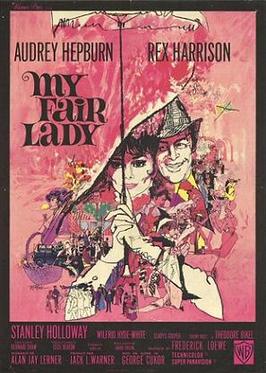
My Fair Lady (1964)

Hardly the Fairest of Them All
****This review contains spoilers****

- Reputations often precede themselves, especially when it comes to film. I often watch a film because I heard from multiple sources that it is a good movie or because this-or-that award ceremony brought it to my attention. Directed by Golden-Age legend George Cukor (The Philadelphia Story (1940), A Star Is Born (1954)), the eight-time Oscar-winning film (including Best Picture, Director and Actor), My Fair Lady (1964) is considered a true classic. With a reputation as one of the best musicals in the history of film, getting around to My Fair Lady was somewhat of a priority for me. However, finally viewing the film proved once again that reputations can be deceiving. Although I enjoyed certain aspects of this highly regarded musical, My Fair Lady ultimately left me rather disappointed.

Director George Cukor presents a stunning visual motion picture. My Fair Lady is a dazzling film; wonderfully framed and colored with some very clever choreography. The scenery is over-decorated and the characters are overdressed - but beautifully so. Just about every major player associated with the look of the film was honored by the Academy: Cukor, cinematographer Harry Stradling (who had actually shot the 1938 version of the story Pygmalion) and costume designer Cecil Beaton (Gigi (1958)) each took home a gold statue for their work on My Fair Lady.

Naturally, this being a musical, Frederick Loewe's songs are the primary feature of the film. My Fair Lady features a number of classic songs including "Wouldn't It Be Loverly," "I Could Have Danced All Night," "I've Grown Accustomed to Her Face" and my personal favorite "On The Street Where You Live" (though I prefer Bobby Darin's arrangement). Of course, for every one good song in the film two or three other songs can be found that die on impact. Despite offering a few unforgettable tunes, most of the songs in My Fair Lady failed to move me; some were down-right boring. Unfortunately, a lackluster music selection is the least of the film's problems.

Based off of the 1956 Broadway musical starring Rex Harrison and Julie Andrews (which is itself a musical take on George Bernard Shaw's play Pygmalion), My Fair Lady follows Cockney "gutter snipe" Eliza Doolittle (Audrey Hepburn) who is taken under the tutelage of phonics professor Henry Higgins (Rex Harrison). Henry has accepted a bet that he can transform Eliza into a proper English lady in only six months' time. In the end, all it took was the promise of shiny new clothes and all the chocolate she could eat to keep Eliza cooped up in Henry's house for half-a-year learning "proper" English. It was a tough road but Eliza defies all odds (all in one night, believe it or not) and gives an unshakable performance at the Ambassador's Ball as a "proper" English lady. However, when Henry fails to rest even a sliver of the credit for the achievement upon her, Eliza runs away out of Henry's care and back to the streets. Henry tracks her down and, despite a long valid list of grievances against Henry and even after a devastating and seemingly decisive fight, Eliza returns to Henry indefinitely. The story contains a number of aspects that holds one's attention throughout but also holds some peculiar elements that, in the end, fail to satisfy.

The first thing that fails where story is concerned is any part of the film that involves the overbearing performance from Stanley Halloway as Eliza Doolittle's father Alfred. The filmmakers' first choice for the role, James Cagney, would certainly have improved the character immensely. Unfortunately, Cagney was determined to remain retired in the 1960s; he would not return to the screen until 1981. However, the problem with the character of Alfred P. Doolittle is that he is absolutely pointless inside the film in the first place. One could literally cut out every scene featuring the character of Alfred and it would not impact the story of Henry and Eliza one bit. Taking Holloway's Alfred out of My Fair Lady would have affected the film in a very positive way as it would have made the story more focused, shortened the very long runtime and saved the audience a lot of annoyance.

The other negative aspect of the story that jumped out at me is the general relationship between Henry Higgens and Eliza Doolittle. Henry is no charming misogynist who learns the error of his ways after falling in love with a good woman - or something like that. No sir, Henry Higgins is a dyed-in-the-wool verbal abuser. Henry wastes no time in calling Eliza names from their very first meeting but the relationship evolves from simple name-calling to general belittling and dismissing. Henry is eventually very happy with his work transforming Eliza into a completely different person - into the person he decided she should be - and by the end of the film is kicking back, demanding that she fetch his slippers. Some cheeky soul will no doubt come at me with some kind of flimsy retort along the likes of, "it's a snapshot of the times!" To that I say: can you picture Barbara Stanwyck or Bette Davis fetching some old jerk's shoes? I think not - not without that guy coming to a pathetic and particularly grisly end.

Rex Harrison's performance of the verbally abusive Henry Higgens won an Oscar. I am flabbergasted as to how this was achieved (especially considering the great list of names he nudged out for Oscar gold, including the legendary performance from Peter Sellers in Dr. Strangelove (1964) which saw him play three different characters). Although occasionally amusing, Harrison's work on My Fair Lady is extremely overblown in general due to the absence of anything resembling depth in his portrayal.

On the other hand, Audrey Hepburn's performance of Eliza Doolittle is fantastic (despite her singing being overdubbed during post-production) and makes the film worth a look all by herself. Hepburn flawlessly convinces in the part, running the gamut as this doppelganger character: absolutely hilarious as the "gutter snipe" version of Eliza, delicately elegant as Eliza's lady counterpart and genuinely engaging and sympathetic in both halves of the role. When people think of Audrey Hepburn, some of the images that immediately spring to mind originate from My Fair Lady: Hepburn gazing from under that great white hat and her graceful figure standing at the top of the staircase. Naturally, Hepburn's classic performance in My Fair Lady was overlooked by the Academy as they were falling all over themselves to honor the lesser members of the cast.

Audrey Hepburn's strong performance goes a long way in redeeming much of the film; however, the abusive relationship between Henry and Eliza still poisons the overall story. My Fair Lady is nearly three hours long and yet the relationship between Henry and Eliza is incredibly underdeveloped. The fact that Audrey Hepburn has even less chemistry with Rex Harrison than she did with the also much older and miscast Humphrey Bogart in Sabrina (1954) does not help create a relationship between their characters but the problem runs even deeper. The film spends plenty of time watching Henry verbally beat down on Eliza but features nothing that bears a resemblance to a flowering relationship. Yet Eliza is seen at the end of the film - after finally standing up for herself against Henry, ready to marry the young Freddie (played by the great Jeremy Brett) - trotting back to Henry's home, preferring to stay with him. The conclusion makes no sense and is completely frustrating due to Henry's abusive nature. The fact that the film failed to define much of a relationship at all leaves the audience irritated and asking the question: is it love or simply the desire for empty but soothing familiarity that brings these characters together at the end?

So.... Mirror, mirror on the wall - which is the fairest musical of them all? Unlike many critics and film buffs, my pick is certainly not My Fair Lady. Audrey Hepburn and George Cukor's visual team put on an enjoyable show; however, plenty of negative aspects exist within the film to take me out of the picture and leave me generally disappointed.  


CBC Rating: 6/10

Friday, December 28, 2012

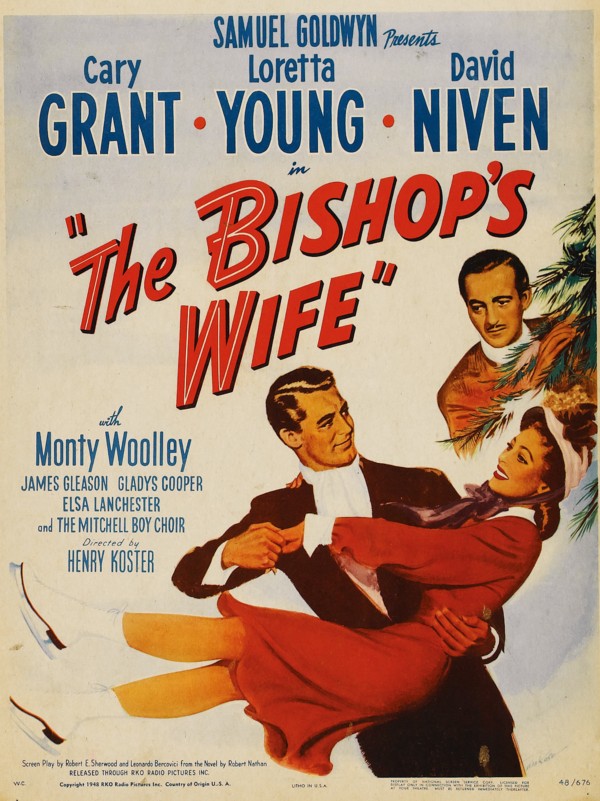
The Bishop's Wife (1947)

Angel With a Wandering Eye

- Christmas is indeed the most wonderful time of the year! One of the many reasons that Christmas is a special time of the year for me is all of the many great Christmas films just waiting to be watched (again and again) that enhance the season. Based on Robert Nathan's novel (and unfortunately poorly remade in 1996), The Bishop's Wife (1947) is one of these films.

Cary Grant stars as Dudley. Of course, since he is personified on screen by Cary Grant, Dudley is a charming, good-natured fellow; but Dudley is no ordinary man. In fact, he is not a man at all: he is an angel. All in the line of divine duty, Dudley brings smiles to people's faces as well as direction and enlightenment to people's lives; though most are oblivious to his holy foundations. When Bishop Henry Brougham (David Niven) prays for guidance amidst a time-consuming and stressful effort to build a new cathedral in a wealthy part of town, straining his relationship with his wife Julia (Loretta Young), Dudley is assigned to help facilitate the Bishop in both his professional and personal life. But as much as Dudley helps, he also impedes when he begins to fall for Julia.

Production on The Bishop's Wife was far from heavenly. Producer Samuel Goldwyn was dissatisfied with what original director William A. Seiter (director of many classic comedies, including installments of legendary Marx Brothers, Laurel & Hardy and Shirley Temple films) had shot, replacing him with Henry Koster (Harvey (1950)). Even this change at director did not equate smooth-sailing for the film, feedback from test audiences was less than perfect so Billy Wilder and Charles Brackett were hired for some final uncredited rewrites. The many personnel changes did not negatively affect the film however, The Bishop's Wife is very well assembled. Gregg Toland (The Grapes of Wrath (1940), Citizen Kane (1941)) does an incredible job photographing the film and replacement director Henry Koster received an Academy Award nomination for his work. 

Although the story generally makes me stop and pause, as the idea of an angel falling for another man's wife at the very least strays into unhallowed territory, The Bishop's Wife contains a lot of spirit and value. Dudley helps the Bishop to see that he not only needs to pay more attention to his family but he must also gain perspective on where his ministry is focused. Sometimes what is big, bold, beautiful and well-intended does not meet the spiritual needs of the many. Of course the story has plenty of room for great comedy, of which the cast and filmmakers did not waste! The many different thematic and comedic elements of the film make The Bishop's Wife a very fun and warm experience. The cast helps this too. Film legends Cary Grant, David Niven, Loretta Young and Elsa Lanchester are absolutely excellent in their roles; Grant's strong presence but humble comedy, Niven's sniveling but sympathetic demeanor, Young's angelic grace and Lanchester's quirky energy really brings the characters and story to life in a fun, engaging way.

Christmas means more than lights, snow, presents or any other material thing but sometimes the right films go far in completing the joy of the season. The Bishop's Wife is one of the better Christmas films around; its wonderful characters, comedy and thematic value make it a seasonal must-see.


CBC Rating: 8/10

Wednesday, December 26, 2012

AVP: Alien vs. Predator (2004)

When (Cinematic) Worlds Collide

- Aliens (1986) director James Cameron described the AVP (Alien vs. Predator) franchise perfectly. One the one hand, Cameron said Alien vs. Predator (2004) is just like "Frankenstein Meets Werewolf." Cameron is absolutely 100% right! A franchise stemming from two originally unconnected films (Alien (1979) and Predator (1987) - fully materializing after a 5th Alien sequel fell through), a comic book series and video game, Aliens vs. Predator was created superficially by Universal Studios. With dollar signs in their eyes, the studio execs hoped that AVP would rake in the dough from the young demographic with its promise of action and gore. However, Cameron continued by saying "then I saw Alien vs. Predator and it was actually pretty good!" Cameron hits it right on the mark again! Despite what one might assume (I surely did), Alien vs. Predator ends up not as bad as it is supposed to be.

The story (developed by original Alien writing team Dan O'Bannon and Ronald Shusett) takes place in 2004 (the earliest setting for an Alien-related film) when an archeological phenomenon in Antarctica gets the attention of the Weyland Corp., Charles Bishop Weyland (Lance Hendriksen) assembles a team, led by Alexa Woods (Sanaa Lathan), to investigate the discovery. What the team soon discovers however is that they are trapped in the middle of an ancient battle between two alien races.

Paul W.S. Anderson's 1997 film Event Horizon is often compared to Ridley Scott's Alien so Anderson was an ideal choice to helm a crossover between the Alien and Predator worlds. His direction, while not particularly impressive, does not exactly disappoint. AVP is not without its obvious problems. Most of the characters are pretty flat, acting out the most predictable plot points and squeezing in a stupid one-liner before either killing aliens or getting killed themselves. Although a lot of very noticeable flaws exist in the film, the photography and special effects are quite enjoyable. Perhaps a little too in-love with the slow-motion technique, Anderson generally assembles a pretty good-looking and exciting picture out of AVP. So the viewer is left with a mixed bag: the characters and script are a bit dodgy but look of the movie is kind of a hit. I would say that the special effects and look of the film alone make AVP at least not awful and at best marginally worthwhile.

The film sees both sides of the quality spectrum with its poor script but enjoyable visuals. The cast coasts in the center of this spectrum, being serviceable at best. Sanaa Lathan does a genuinely good job working around the generally poor dialogue and weak castmates she was forced to work with, creating a believable character out of the adventuring Alexa Woods. Lance Henderiksen (who co-starred in both Aliens and Alien 3 (1991)) is also fairly impressive as Weyland Corp. head Charles Bishop Weyland largely thanks to his naturally commanding screen presence. The film is full of recognizable supporting faces: Tommy Flanagan (Gladiator (2000)), Ewen Bremner (Black Hawk Down (2001)) and Colin Salmon (The World Is Not Enough (1999)). Unfortunately, Lathan and Hendriksen give the only two performances that are worth any kind of praise.

But what I found particularly enjoyable about AVP was how the film depicts the interaction with the predators, (xenomorph) aliens and humans. Perhaps an odd couple on original consideration, the predators and xenomorph aliens are a good match for one another. Both aliens were actually (at least partially) developed by special effects artist Stan Winston and there is a clear match between the phallic facial features of the alien and the vaginal features of the predator. The film attempts to give a backstory that intertwines the three races throughout history (to be slightly borrowed from by Ridley Scott's Alien prequel Prometheus (2012)) some of which works and some of which does not. Part of the story that does not work is not the fault of Anderson for the whole of AVP, it just ends up clashing with what Ridley Scott decided to develope for his Alien prequel Prometheus. I would argue that Scott's vision for the series ends up the more interesting of the two but AVP can only be faulted so much.

However, the best aspect of the film is that we see much more character out of the predators than what has been portrayed on film in the past, which makes AVP a much more important film for the Predator series. In the great original Predator, the predator was a mysterious hunter but the race was unfortunately not further explored in the mediocre sequel. However, in AVP the predators are shown to have a culture and moral code which gives depth to the series. Naturally, the exact opposite occurs for the Alien creatures. Unlike how the film appreciates the culture and honor of the predator aliens, the xenomorph aliens are presented as little more than animals. While this depiction of the alien creatures is partly accurate in the series, it also goes against a lot that is seen in the previous Alien series which hints at a clear alien intelligence.

I feared the worst as I began my journey into the back allies of the Alien series known as the Alien vs. Predator franchise but the 2004 Paul W.S. Anderson film was surprisingly entertaining. One could suggest that perhaps my expectations were so low that nothing could have been bad enough to disappoint. To that I say - OH YEAH? Well, maybe *your* standards are just too high?! Certainly not as interesting, stylish or impressive as other films in either the Alien or Predator series, AVP does manage to entertain as a bloody blow'em'up sci-fi flick.

Unfortunately, the AVP sequel could not match strides.


CBC Rating: 6/10